Let’s face it: Skin conditions are not fun to deal with. Maybe they’re issues you have been treating for a while, but sometimes they can appear on the skin seemingly out of nowhere. It’s easy to misdiagnose yourself, because to the untrained eye, different rashes and discolorations can look similar. And, to make things more complicated, some conditions can overlap with each other.
Here, Raechele Gathers, M.D., a dermatologist with Henry Ford Health, reviews the defining characteristics of several skin conditions, what set them apart from each other and how your dermatologist can help you treat them.
Commonly Diagnosed Skin Conditions
Eczema (Atopic dermatitis)
What it is: An itchy skin rash that’s part of the “atopic triad,” meaning those with eczema often also have allergies and asthma. While many children outgrow it, the condition can continue into adulthood, and some people develop adult-onset eczema.
What it looks like: Scaly patches of skin that can appear on any part of the body during infancy. In children and adults, eczema often favors the inner wrists and elbows, behind the knees and neck. In people with darker skin tones, these patches can look hyperpigmented and brown, or they can look pink or red. In people with lighter skin tones, they can look red or pink.
How to treat it: Don’t scratch—doing so can worsen eczema. A topical steroid or anti-inflammatory therapy can help manage itching, though treatment varies depending on your age, the affected area and severity of the condition. To prevent flare-ups, avoid triggers such as soaps, detergents or skincare products that contain fragrances and moisturize regularly to prevent dryness.
Tinea Versicolor
What it is: An overgrowth of yeast living on the skin. We all have microscopic organisms on our skin, including a yeast called Malassezia. Some people are simply more prone to an overgrowth of this yeast. It often first appears during the teenage and young adult years, when oil glands are most active. Sweating in warm or humid weather can cause flare ups.
What it looks like: Patches of discoloration that usually appear on the neck, shoulders and chest. The discoloration can vary - some people have light patches; others have dark patches. Cases are often asymptomatic but can sometimes be mildly itchy.
How to treat it: Selenium sulfide is an antifungal treatment used to treat tinea versicolor. Other anti-fungal creams may also work. Your dermatologist can recommend the best treatment for you but know that it can take weeks to months before the discoloration goes away completely.
Rosacea
What it is: A chronic inflammatory condition that often resembles acne. This condition has many possible causes including genetics, immune dysregulation, vascular changes, microorganisms and environmental triggers. Rosacea typically begins to affect people in their late 20s and into their 30s, 40s and 50s.
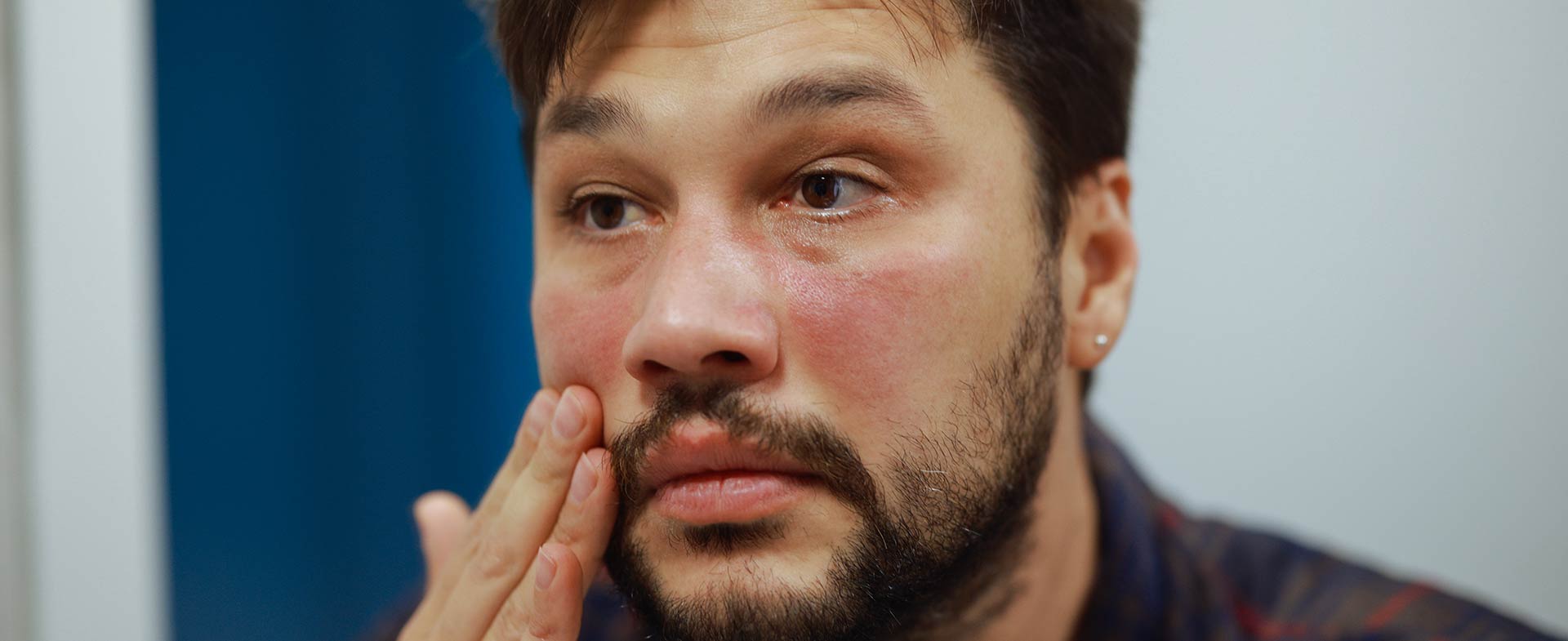
What it looks like: How it presents can vary. Sometimes it looks like red, flushed skin (typically limited to the face) with broken capillaries and small, red bumps that look like tiny pimples. It can look different in darker skin tones, and in some men, rosacea can appear as thickened skin or a buildup of tissue on and around the nose. It can cause burning, stinging, sensitivity, bumps or even brown, violet or dusky coloration of the skin.
How to treat it: Work with your dermatologist to identify possible triggers, use gentle, fragrance free products and wear a broad-spectrum sunscreen with SPF 30 or higher daily (mineral sunscreens may be better tolerated by some people with rosacea).
Acne
What it is: An inflammatory skin condition that develops when hair follicles become clogged with excess oil or dead skin cells. Bacteria and inflammation can also contribute to the formation of pimples, whiteheads and blackheads. There is a genetic predisposition for acne, but it usually first appears during the teenage years because of fluctuating hormones and increased oil production. For some people, it can continue throughout adulthood. A specific type of bacteria on the skin, called Cutibacterium acnes, can also contribute to breakouts.
What it looks like: Raised bumps on the skin. Acne cysts are large bumps, while whiteheads are small bumps with a white surface and blackheads are small bumps with a dark surface.
How to treat it: Benzoyl peroxide-based cleansers or washes help reduce acne-associated bacteria and inflammation, and salicylic acid treatments unclog pores. Over-the-counter retinoids (such as adapalene) can help prevent blackheads and whiteheads by increasing cell turnover.

Dermatology At Henry Ford
Psoriasis
What it is: An inflammatory immune disorder that also affects other areas of the body. (It's not just a skin disorder.) Psoriasis can present at any age, but traditionally tends to manifest during your 20s, 30s or 40s. It may be associated with other health conditions including heart disease, insulin resistance and psoriatic arthritis.
What it looks like: Defined, raised patches of skin that have a thick scale. In people with darker skin tones, these patches can look hyperpigmented and brown, or red or pink with a thick white scale. In people with light skin tones, they can look red or pink with a thick white scale. Any part of the body can be affected, but psoriasis typically appears on the elbows, knees and torso. Some people have guttate psoriasis, meaning they have small raindrop-like spots all over the body.
How to treat it: Your treatment plan depends on the location and severity of the disease. It may include topical medications, phototherapy (the use of light waves to treat skin conditions) or systemic medications.
Even with this knowledge, skin conditions should not be self-diagnosed. Instead, leave it to your board-certified dermatologist to identify and recommend treatment – especially if your rash is persistent, recurring, painful or getting worse.
Reviewed by Raechele Gathers, M.D., a board-certified dermatologist who sees patients at Henry Ford Medical Center – New Center One and Henry Ford Dermatology – Farmington Road.