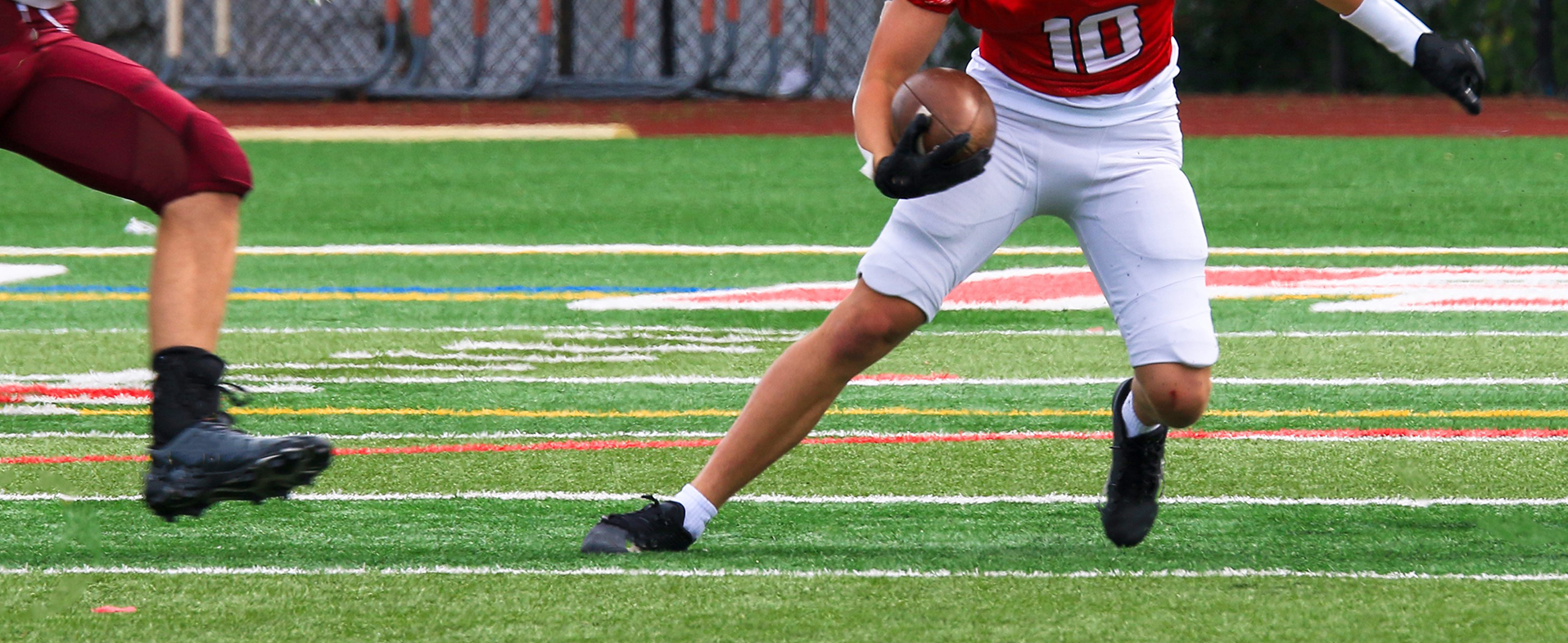
Anyone who plays a turf sport like soccer or football is at risk for spraining their big toe – a condition known as turf toe.
“Turf toe occurs when players have their foot pointed downward, away from their body and they hyperextend their toe when pushing off the ground,” says Nicole Brouyette, DPM, a foot and ankle surgeon at Henry Ford Health. “Artificial turf isn’t as forgiving as grass. When you do this on turf, you can sprain the ligaments surrounding your big toe.”
But even people who don’t play turf sports can get turf toe – as many gyms now have areas with artificial turf. If you’re doing exercises like high-intensity interval training or box jumps on turf, you’re at risk for spraining your toe. Your foot shape can also predispose you to turf toe – and those with bunions are more prone to turf toe.
Symptoms & Diagnosis of Turf Toe
Redness of the big toe joint, stiffness and pain are symptoms of turf toe.
“If you develop these symptoms after an athletic activity, you should be evaluated by a medical professional – even if you think you can fix it with rest and ice,” says Dr. Brouyette. “Further progression of turf toe can lead to osteoarthritis and surgery.”
Diagnosing turf toe involves radiographic imaging. Three views of your foot are taken in the doctor’s office. “We can actually move the big toe joint through its range of motion and see whether the ligament has ruptured – a rupture is the most severe form of turf toe,” says Dr. Brouyette.
Treating Turf Toe
The severity of turf toe is graded on a scale from one to three. Each grade has different treatment needs. All, however, use some type of stiff shoe, boot or sling to limit the motion in your foot. “Limiting the motion helps decrease inflammation to let your toe heal and prevent your joints from breaking down in the future,” says Dr. Brouyette.
Turf Toe Grade 1
Grade 1 is the least severe form of turf toe. “We’ll do RICE therapy, which stands for rest, ice, compression, elevation,” says Dr. Brouyette. “We’ll also give you a carbon-fiber, stiffed soled shoe to hold the toe joint in place. You can still move around, but we’re trying to keep the big toe joint as stable as possible.”
It usually takes two to three weeks of rest to heal a grade one turf toe.
Turf Toe Grade 2
Grade two means your toe ligament has torn but not completely ruptured.
“If you have a minor grade two, we’ll put you in a boot or cast to keep the toe stiff,” says Dr. Brouyette. “If you’re on the more severe side of grade two, we’ll have you wear a splint that holds the toe down and keeps the foot as stable as possible. It keeps the big toe in a plantar flex position – meaning a downward position – and allows your foot to relax and heal itself.”
Grade two usually requires 4 to 6 weeks of splinting or immobilization with a boot, along with physical therapy afterward, before you can get back to playing your sport.

Foot and Ankle Care at Henry Ford Health
Turf Toe Grade 3
Grade three means your toe ligament has fully ruptured. “This typically requires surgery to prevent osteoarthritis and to help you get back to your sport sooner rather than later,” says Dr. Brouyette. “If grade three isn’t treated, you can become arthritic, which requires a more in-depth surgery. Turf toe can be devastating if it isn’t treated properly.”
After surgery, Dr. Brouyette recommends keeping your toe stiff with a boot or cast for four to six weeks, along with physical therapy afterward. It generally takes about three months to return to your sport.
Preventing Turf Toe
Having the right shoe gear is important to protect your feet from turf toe.
“If you’re an everyday athlete – working out on turf at your gym or playing recreational sports on turf, for example – make sure you have a stiff-soled shoe that doesn’t have very much give in the forefront,” says Dr. Brouyette. “You can also add a carbon fiber insert into your running shoe. If you’re a professional athlete playing on turf, wear cleats because they are already made to be stiff and protective.”
Stretching for at least 10 to 15 minutes after exercising is also key, as that’s when your muscles are warmed up. “Stretch your hamstrings, calves and Achille’s tendons,” says Dr. Brouyette. “This will take the pressure off your forefeet in the long-term.”
Reviewed by Nicole Brouyette, DPM, a board-certified podiatric surgeon who sees patients for podiatric needs at Henry Ford Hospital — Detroit, Henry Ford Medical Center — Fairlane and Henry Ford Medical Center – Pierson Clinic.

